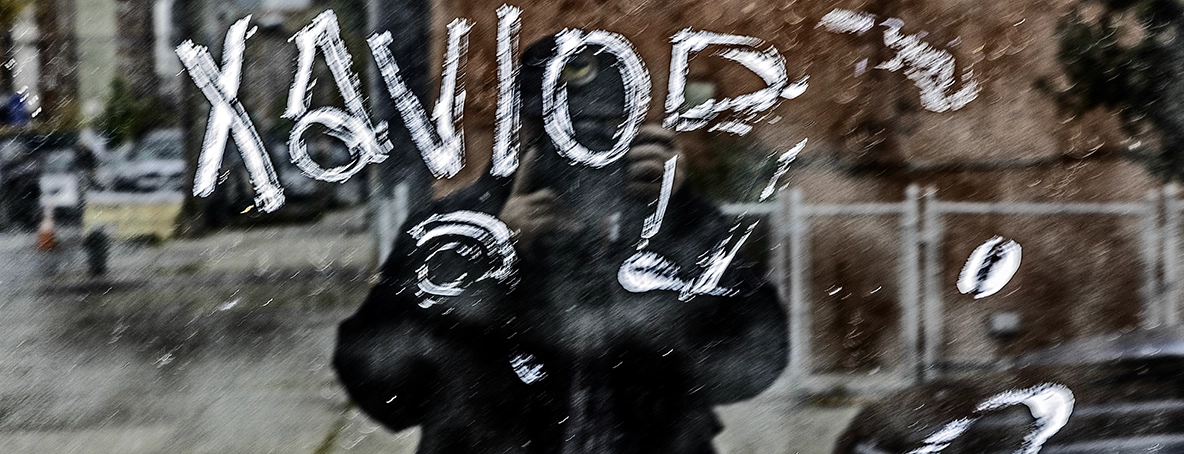
Bio
Before I was born, my father was in the Army. While he was serving in the Korean War, my father put some cash in an envelope and mailed it to a US Army Post Exchange in Japan. In return, he received a camera by Army postal service. When I was young, my father gave me that camera. Aside from crayons and pencils, that camera was the first tool I remember using to create images—it was also the first time I was conscious of using a tool to create images.
Early stylistic influences
In college I studied in the studio art program at Columbia University with important established artists in New York. This program exposed me to a number of great artists, all of whom impacted my way of thinking as well as my way of seeing. Here are some of them.
Most important for me was André Racz who taught drawing, and was friend and mentor to a small group of us. He spent time with me away from the academic setting to discuss art as seeing, bringing me to his home and studio in Demerest, NJ where we could talk and compare our unique visions. He used art and teaching to help learn about ourselves. At Atelier 17 in New York, his prints could be described as being surrealist or expressionist, and later his matured style was more calmly representational and expressive. He is the source of the directness I feel for arriving at an image.
André Racz: at MOMA and on Wikipedia
Also at Columbia was painter David Lund, identified as being of the New York School of abstract expressionism, he taught painting and took an exceptional interest in technique and composition, encouraging my pursuit of personal themes. David revealed the wonders of the use of color, and texture, two ideas I am aware of in my own work.
David Lund: a web site about him, and on Wikipedia.
Robert Blackburn taught printmaking at Columbia, which involved the discipline of process—he was especially supportive and encouraging of my experimentation in monoprints. Monoprints is close to drawing in that it can create unique images, but also has aspects of photography in that you can almost create multiple variations of a single image idea. Printmaking requires discipline in the process, but a unique and vibrant image is the result of that process. In a way I use the digital processes of modern photography, with the ability to insert the hand of the artist into the product, to create prints.
Robert Blackburn: on the Smithsonian site, and on Wikipedia.
Here are more of the influential artists I encountered at Columbia.
Leon Goldin: a web site about him, and at MOMA.
Joan Snyder: a web site about her and on Wikipedia.
Bill Barrett: a web site about him and on Wikipedia.
Roland Ginzel: at The Annex Galleries and on a Wiki about him.
The photographer makes the image
This mixture of influences, from abstract expressionist and surrealist, the more matured objective visions of the teachers I encountered at Columbia, and the art of the 70’s and 80’s form the primordial creative soup from which I come. Although the tools are secondary to the vision, I keep returning to the camera as a primary tool and medium of choice, especially now that digital imaging opens a whole range of possibilities to create images.
My images are not accidents—the camera does not reveal things that do not exist, but can reveal the things we filter out when looking directly at them. As a tool, it reveals—street reflections in a window, or an urban landscape reflected in the glass of a building. Using the images that a photograph creates is idealism and romanticism, form and color and profundity all wrapped up together. There are visual patterns, textures, and colors at play, and the ironies of the representational forms. At the same time, I am immersed in and part this process, so that what comes out of what I do is no different than who I am.
I control all of the creative aspects involved in my work, from the initial exposure to the final printed piece. My work rendered as giclée prints from high resolution files using acid free papers.